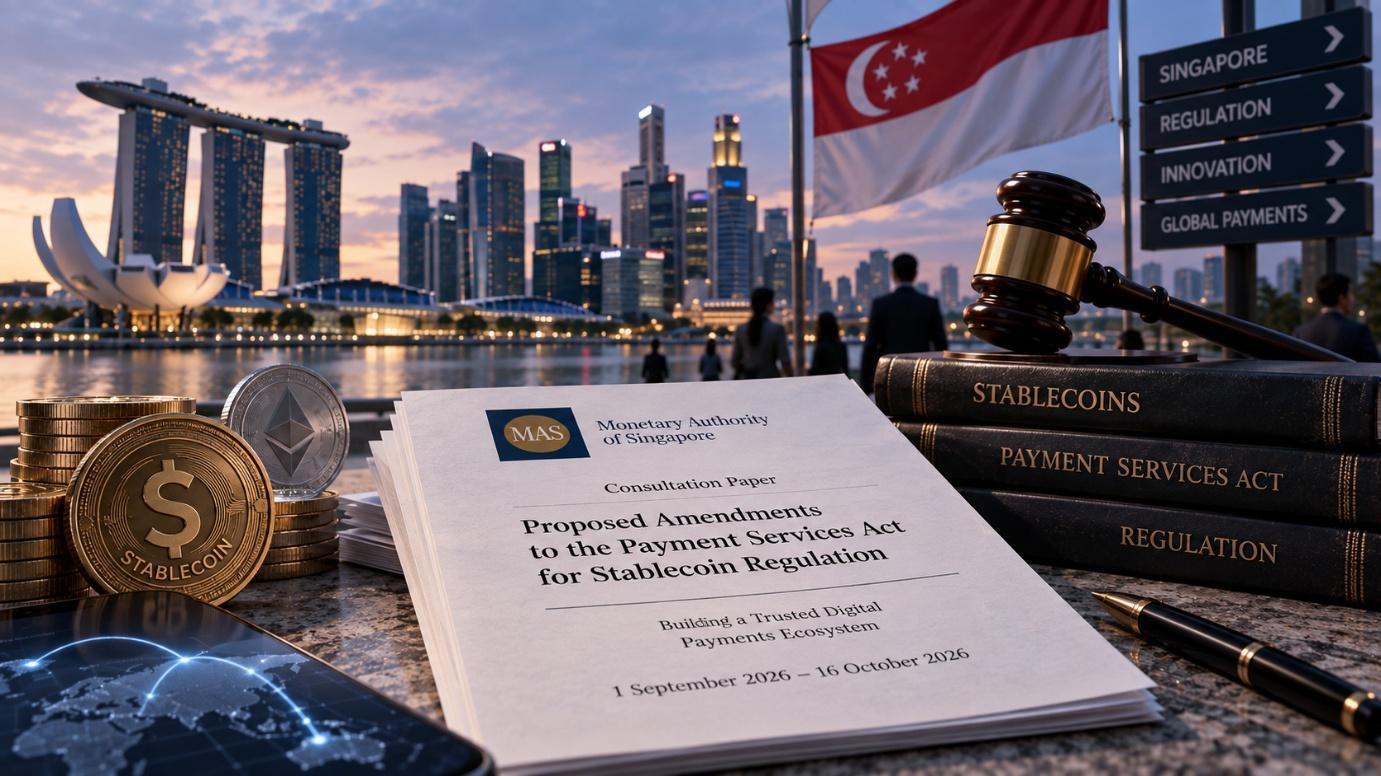
Singapore is getting closer to making its stablecoin rules into law. Regulators are now thinking not just about local use, but also about how digital currencies are being used more often across borders.
On 1 September, the Monetary Authority of Singapore started a public consultation about changes to the Payment Services Act 2019. These changes would make the Single-Currency Stablecoin framework legally binding and set out what issuers need to do before they can call their tokens MAS-regulated stablecoins. The consultation is open until 16 October.
Cross-border use is becoming part of the regulatory question
Singapore’s framework goes further than simply defining what counts as a regulated stablecoin. MAS is also asking how tokens issued across more than one jurisdiction should be handled and whether selected foreign-issued stablecoins could eventually receive recognition when they operate under comparable regulatory regimes.
That matters because stablecoins increasingly sit inside a much broader payment ecosystem. They are used for trading and settlement, but they can also provide payment rails for digital services ranging from marketplaces to crypto gambling sites. Once those services operate across borders, questions around reserve quality, redemption and regulatory responsibility become significantly harder to keep within a single jurisdiction.
The proposal would allow stablecoins jointly issued by a Singaporean and a foreign issuer to come within the MAS framework when the associated risks are sufficiently controlled. MAS is also considering recognising a limited number of foreign stablecoins where the overseas regime offers comparable safeguards.
Regulation is shifting towards the infrastructure behind the token
One of the most important parts of the proposal is the distinction between a token that merely calls itself a stablecoin and one that has met defined regulatory standards.
Under the proposed model, issuers wanting to use the MAS-regulated label would face requirements covering value stability, capital, redemption at par and disclosure. Stablecoins outside the framework would continue to be treated as Digital Payment Tokens rather than automatically receiving the same regulatory status.
The Monetary Authority of Singapore's announcement says the distinction is intended to make it easier for users to identify tokens subject to specific safeguards.
It is an important shift in emphasis. Regulators are paying less attention to the word used to describe a digital asset and more attention to what actually supports it: the reserves behind it, the redemption mechanism and the entity responsible if something goes wrong.
Singapore is also looking beyond its own market
The cross-border element is particularly relevant to Singapore because of its role as a regional financial centre. Stablecoins can move between markets far more easily than conventional banking products, but regulation remains largely jurisdictional.
Singapore has already been experimenting with other forms of digital settlement and tokenised finance. Its approach suggests that the next phase of stablecoin regulation will not only be about determining whether issuers are safe domestically, but also about deciding when one jurisdiction can trust the standards imposed by another.
That could prove difficult. Comparable regulation does not necessarily mean identical regulation, and authorities will have to decide how reserve rules, audits, consumer protections and redemption rights translate across borders.
The consultation therefore represents more than another piece of crypto legislation. It is an attempt to define how regulated digital money can operate when the technology is global but responsibility for supervising it remains local.