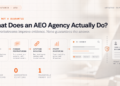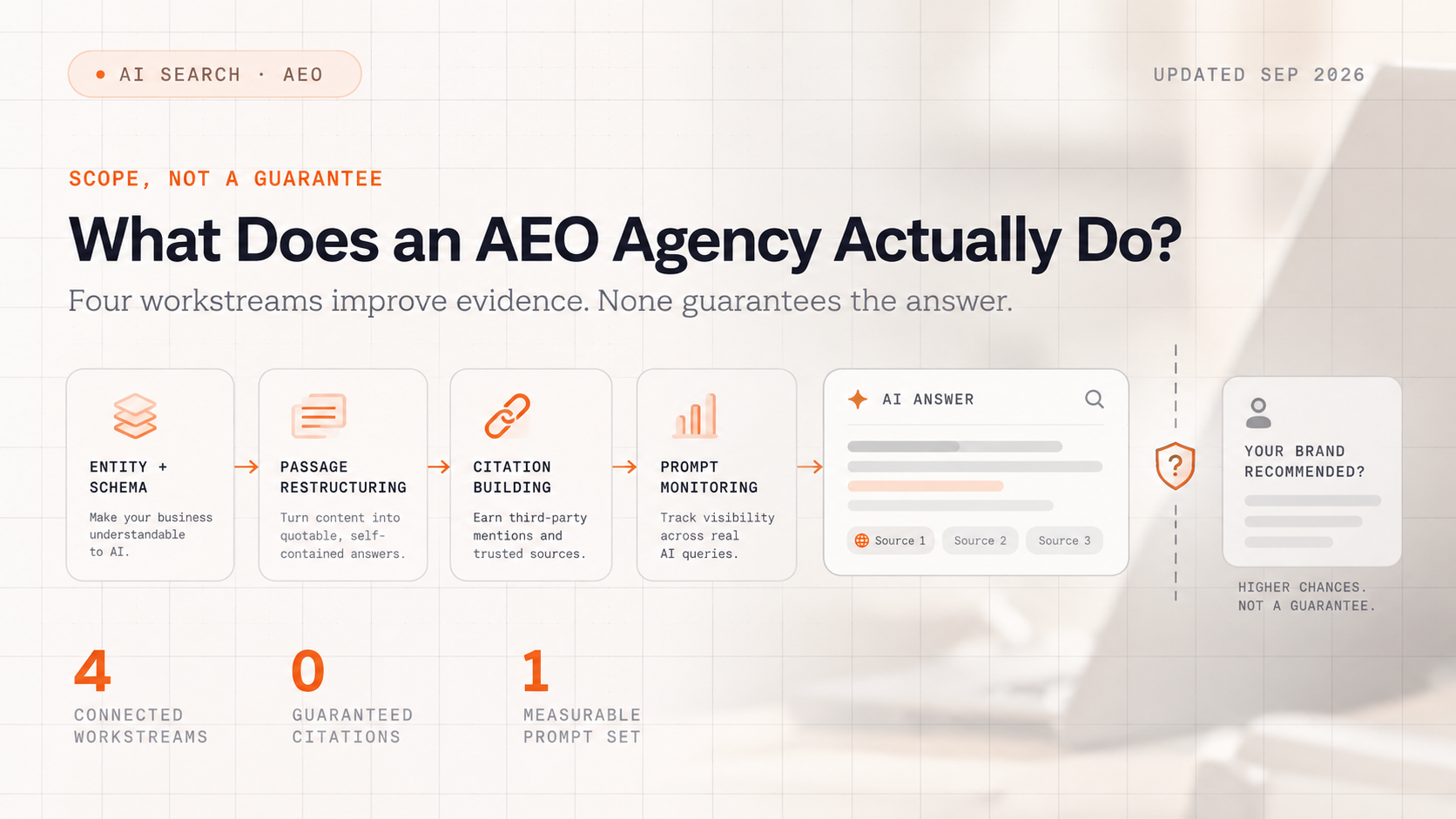
An answer engine optimisation agency improves the evidence AI systems use to find, understand and corroborate a business. A serious engagement covers 4 connected workstreams: entity and schema work, passage-level restructuring, off-site citation building and repeated prompt monitoring. None of these 4 workstreams guarantees a specific AI recommendation.
Keyfacts
- Entity and Schema Work: Clarifying the business’s name, locations, and services so AI systems can accurately identify its core facts without guesswork.
- Passage-Level Restructuring: Formatting on-page content to surface specific, self-contained answers that AI models can easily retrieve and quote.
- Off-Site Citation Building: Establishing independent corroboration across the web (like industry directories and reviews) to verify the business’s claims.
- Prompt-Set Monitoring: Measuring visibility by running a stable set of buyer questions across AI engines over time to track “AI share of voice.”
What Are You Actually Paying For?
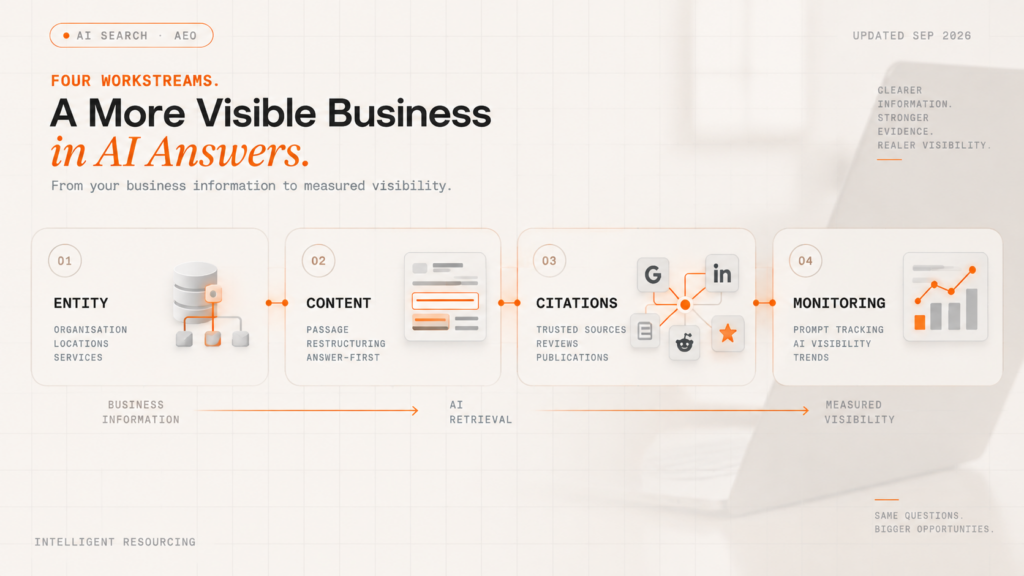 Alt Text Image 02: Four AEO workstreams showing entity optimisation, content restructuring, citation building and AI visibility monitoring.
A credible AEO scope covers 4 connected workstreams that move from technical foundations through to ongoing measurement. Each workstream changes something specific and cannot guarantee something else. Before comparing quotes, check what the market charges: an answer engine optimisation agency in Australia has published its pricing alongside an independent benchmark of Australian retainer ranges.
|
Workstream |
What changes |
What it does not guarantee |
|
Entity and schema |
Makes the business, locations and services clearer to AI systems |
An AI citation |
|
Passage restructuring |
Makes useful answers easier to retrieve from a page |
That a model selects the passage |
|
Third-party citation building |
Strengthens independent corroboration of the business |
Control over which sources are trusted |
|
Prompt-set monitoring |
Measures visibility across real buyer questions |
A permanent ranking position |
The 4 workstreams are connected. If the business entity is unclear, content can reinforce the wrong relationships. If the site is already clear but the wider web barely confirms what it says, publishing another homepage paragraph will do little. And if nobody measures the same buyer questions over time, the business cannot tell which changes produced observable movement.
That is why AEO is better understood as evidence engineering plus measurement than as a new name for writing blog posts.
What Does a Real AEO Problem Look Like Before Work Begins?
AEO engagement starts with a diagnosis of where the evidence chain breaks, not with an assumption that the website needs more copy. A business can already publish accurate, crawlable entity information and still fail to appear in relevant AI responses. The gap is usually off-site evidence or unclear entity signals, not missing keywords.
Consider a Perth water filtration specialist called Water2Water, a business with more than 25 years of experience, covering domestic, commercial and industrial systems across Perth, Karratha and wider Western Australia.
Its own website already establishes most of the facts a buyer would expect to find: its services, its head office location, its service areas and its depth of experience. Those are concrete, useful entity facts.
Yet imagine the starting prompt set shows a recurring problem.
A local buyer asks an assistant:
“Which water treatment company should I use in Perth?”
The company rarely appears, that is where a proper AEO engagement begins. Not with the assumption that the website needs more keywords, but with a diagnosis of where the evidence chain breaks.
What Does Entity and Schema Work Actually Change?
The first workstream makes search and AI systems identify a company, its locations, services and relationships without inference from inconsistent pages. Structured data belongs here, but it is a narrower tool than most AEO proposals suggest, and schema alone does not switch on AI citations.
The agency audits four things:
- Whether the organisation uses one consistent name across its pages
- Whether its primary company page is clearly identifiable
- Whether address and service-area information agree across all pages
- Whether service pages clearly relate back to the same parent organisation
Google’s schema guidance confirms Organisation structured data can help disambiguate a business, but makes no promise that adding schema produces AI citations.
For the filtration business, this workstream covers making its Perth and Karratha relationships explicit, validating organisation and location markup, connecting service pages to the main entity and checking that visible copy agrees with structured data.
The crawler layer matters as well. OpenAI says sites that want content to be discoverable in ChatGPT Search should allow OAI-SearchBot access. Placement itself is not guaranteed either way.
What does this workstream change?
It reduces ambiguity. AI systems have less reason to guess or infer the wrong relationships.
What does it not do?
It does not switch on citations. A schema test of 1,885 pages that added JSON-LD found no meaningful citation uplift in ChatGPT or Google AI Mode attributable to the schema change alone. Schema helps describe the entity. It is not a recommendation button.
What Is Passage-Level Content Restructuring?
Passage-level restructuring makes important answers easy to locate inside a page rather than burying them in generic marketing language. The objective is not to publish more content but to surface specific, retrievable evidence so that an AI system can quote the page accurately for the right buyer question. This begins once the entity layer is clear.
Suppose a service page says:
“We deliver quality water solutions tailored to every requirement.”
It sounds acceptable to a human reader, but it contains very little evidence.
A stronger passage says:
“The company installs and services domestic, commercial and industrial water filtration systems across Perth and Western Australia, with additional servicing capability in Karratha and the Pilbara.”
The second version carries an entity, a service, an audience and a location in one self-contained answer. That is passage-level restructuring.
An agency working on passage restructuring typically:
- Rewrites introductions so the answer appears first, not at the end
- Converts buried comparisons into tables
- Adds concise question-led sections where buyers have clear intent
- Surfaces evidence beside claims rather than separating them
- Removes repeated marketing language that adds no new information
Google’s AI search guidance recommends useful, people-first content. It says there is no requirement to break pages into tiny chunks or rewrite copy in a special machine-only style for generative search.
What changes?
The relevant answer becomes easier to retrieve and quote.
What does not change automatically?
Whether an answer engine decides this page is the best supporting source for a given question. That decision depends on evidence beyond the website itself.
What Is Off-Site Citation Building?
If a site clearly describes a business but AI systems still overlook it, the missing layer is usually independent corroboration rather than more on-page copy. A business’s own pages are not sufficient evidence for an AI system that can retrieve independent sources. Off-site citation building addresses that gap directly, and it is the workstream most commonly absent from a standard content retainer.
The contrast is easiest to see in the worked example.
Water2Water can clearly state its Perth base, Karratha presence, WA service coverage and filtration expertise on its own pages. An answer engine, however, is free to retrieve independent sources as well. If competitors are corroborated across industry pages, local directories, reviews and editorial coverage while Water2Water has little comparable evidence, rewriting its homepage again does not solve that gap.
That is what third-party citation building is supposed to address. It is not simply traditional link building under another name.
A sensible programme looks for places where the business can be legitimately described and corroborated:
- Industry association directories
- Professional body listings
- Partner and supplier pages
- Customer case studies on third-party sites
- Regional and industry publications
- Specialist review platforms
- Local business and chamber of commerce profiles
The quality and context of the mention matter more than manufacturing volume. AI citation research tracking 944 prompt-platform combinations found brands with independent web mentions are cited at 34%, compared to 7.6% for brands with none. The research notes this is a correlation, not proof of causation, but it supports the principle that a brand’s wider web presence is part of the environment associated with AI visibility.
The example is useful because the type of corroboration can be seen in practice. Water2Water has an external City of Subiaco business profile describing it as a locally based filtered-water business serving Perth customers. That is the sort of independent entity confirmation this workstream aims to develop.
What changes?
The business becomes easier to verify beyond its own claims.
What does not change automatically?
Which of those independent sources a particular answer engine will retrieve for a particular question. That is why the fourth workstream matters.
How Is AEO Visibility Measured?
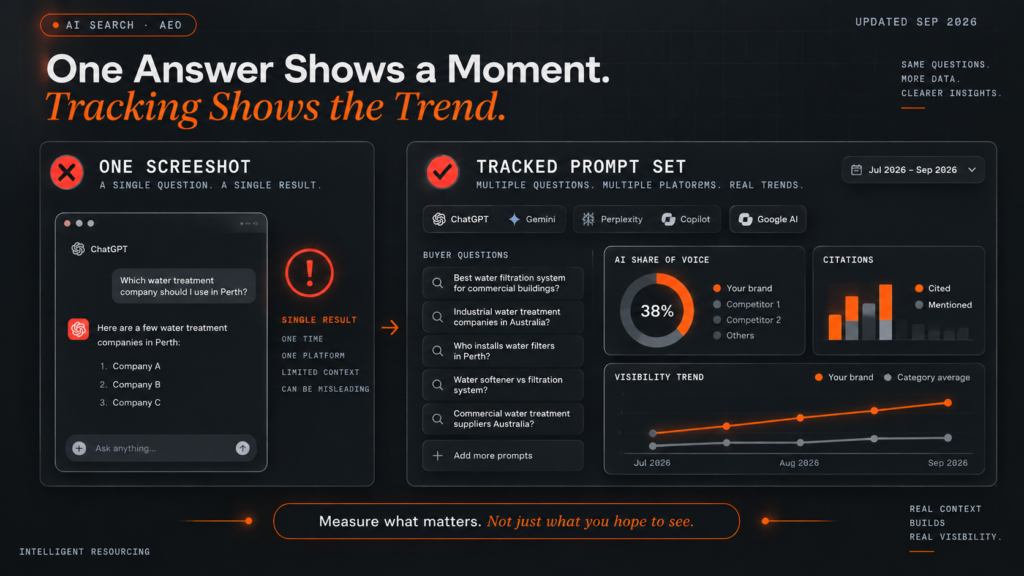 Alt Text Image 03: AI visibility measurement comparing a single chatbot screenshot with tracked prompt monitoring across multiple AI platforms.
Prompt monitoring determines whether the first 3 workstreams are creating observable visibility changes. Without a fixed measurement set, an agency can always find a favourable AI response somewhere. That is not measurement. Measurement is a stable set of buyer prompts, run repeatedly across agreed engines, with share of voice tracked over time.
For the filtration example, a tracked set includes questions such as:
- “Which water treatment company should I use in Perth?”
- “Who installs commercial water filtration systems in Perth?”
- “Which companies provide whole-house water filtration in Western Australia?”
The wording remains stable enough to compare results across months.
|
Prompt |
Engine |
Brand mentioned? |
Competitors noted |
Citations |
Date |
|
Which water treatment company should I use in Perth? |
ChatGPT |
Yes / No |
Recorded |
Recorded |
Date |
|
Same prompt |
Gemini |
Yes / No |
Recorded |
Recorded |
Date |
|
Same prompt |
Perplexity |
Yes / No |
Recorded |
Recorded |
Date |
The core measure is straightforward:
AI share of voice = prompt runs where the brand appears / total prompt runs
The point is not to claim that the brand now “ranks number three in ChatGPT”. There is no stable number-three position to own. Instead, the buyer can ask whether the brand appeared in 10%, 30% or 60% of relevant prompt runs, which competitors appeared more often and which sources repeatedly supported those competitors.
That turns AEO from a screenshot exercise into a measurable programme.
What Can an AEO Agency Not Control?
An agency can improve the evidence around a business. It cannot control the final output of an independent AI model. That distinction should appear clearly in any proposal. A provider who guarantees a ChatGPT recommendation or a permanent AI position is overstating what the evidence supports.
It cannot guarantee a ChatGPT recommendation
OpenAI’s documentation on ChatGPT Search states that placement is not guaranteed and that search results and citations can be incomplete, outdated or incorrect. A provider can improve crawlability, clarify information and strengthen the evidence ecosystem. It cannot force the model to return a particular sentence.
It cannot use schema as a citation switch
Google says there is no special schema.org markup required to appear in AI Overviews or AI Mode. It recommends structured data as part of normal search hygiene, with the additional requirement that markup accurately matches visible content. That is valuable technical work. It is not a secret AEO lever.
It cannot turn an organic ranking into an AI citation
Organic search remains relevant, but the relationship is not one-to-one. AI Overview research tracking 51,745 links found 41% also appeared in Google’s top 10 for the same query. The other 59% of AI Overview sources did not appear in the first 10 organic results at all.
The accurate conclusion is not that SEO rankings no longer matter. It is that a traditional search position does not transfer directly into an AI citation position. Both matter, and both require separate tracking.
What Should a Buyer Actually Receive?
A serious AEO engagement leaves behind auditable deliverables at each stage, not a monthly report claiming AI visibility improved. Buyers should specify the deliverable format before signing. An agency that cannot describe its outputs by workstream is usually selling a service, not running a programme.
|
Stage |
Expected deliverable |
|
Baseline |
Fixed prompt set and current share of voice across agreed engines |
|
Entity audit |
Entity map, crawler findings and schema corrections |
|
Content |
Prioritised passage and page rewrites with before/after examples |
|
Off-site |
Citation-gap analysis and corroboration-source map |
|
Monitoring |
Repeat prompt tracking across agreed engines |
|
Reporting |
Brand mentions, citations, competitor appearances and source changes |
If the diagnosis shows that the website already answers the relevant question clearly, the agency should not default to selling another 20 articles. If the real gap is off-site evidence, the work should move there. The sequence of deliverables matters as much as the list.
How Much Should an AEO Engagement Cost?
Buyers should compare pricing against the scope of work. Two providers can use the same AEO retainer label while delivering completely different programmes. The comparison that matters is not headline price but what is actually included.
Before signing, compare the quote against a published benchmark. Intelligent Resourcing’s 2026 pricing guide covers Australian AEO retainer ranges and publishes its own diagnostic and retainer prices. Those figures are vendor-published rather than an independent industry survey, so they are most useful as a comparison point rather than a universal market rate.
The more important comparison is scope. Before signing, ask:
- Does the fee include technical implementation?
- Does it include off-site citation work?
- How many prompts are monitored each month?
- Which engines are covered?
- Who owns the tracking data at the end of the engagement?
A lower quote covering only content production is not necessarily cheaper if the business’s actual problem sits somewhere else.
What Should You Ask Before Signing with an AEO Provider?
The fastest way to test an AEO proposal is to ask 3 things: what it changes, how it measures success and what it refuses to guarantee. The answers reveal whether the scope covers real workstreams or is a packaged name for standard content services.
- What is our baseline? Ask to see the buyer prompts, current brand visibility, competitors and source patterns before implementation begins.
- Which engines are monitored? A single favourable platform does not describe the whole market.
- How do you diagnose the gap? The provider should explain when a problem is technical, content-related, off-site or measurement-related.
- What exactly changes on-site? “Optimisation” should translate into concrete pages, passages, schema or technical fixes.
- What does citation building involve? It should mean credible corroboration, not bulk links or manufactured mentions.
- How often are prompts rerun? Repeatability matters because generated answers change over time.
- What do you guarantee? Be cautious if the answer includes guaranteed model recommendations or permanent AI positions.
- How does pricing map to scope? Ask what each fee pays for rather than comparing retainers by headline price alone.
- Can we keep the data? A buyer should retain enough historical evidence to judge whether visibility actually moved.
Why Is AEO a Scope of Work, Not a Model Guarantee?
The practical value of an AEO agency is not access to a lever that makes ChatGPT recommend a company. It is the ability to improve and measure the evidence from which answer engines build their responses. A proposal that covers 4 workstreams and separates what the provider controls from what the model controls is assessable like any other technical programme.
The work has a logical sequence:
If a proposal covers those 4 areas and clearly separates provider control from model control, a buyer can evaluate the engagement on deliverables, measurement and movement.
If it promises guaranteed citations, a fixed ChatGPT ranking or special markup that forces inclusion, the promise is stronger than the evidence supports.
FAQs
What does an answer engine optimisation agency do?
An AEO agency improves how clearly AI and search systems can find, understand and corroborate information about a business. Typical work includes technical and entity audits, content restructuring, third-party evidence development and repeated monitoring of commercial buyer prompts.
Is AEO just SEO with schema?
No. Schema can help clarify an organisation and its attributes, but there is no special structured-data requirement for appearing in AI Overviews or AI Mode. A broader AEO programme also addresses content quality, third-party evidence and visibility measurement.
Can an AEO agency guarantee ChatGPT citations?
No provider controls ChatGPT’s final source selection. OpenAI states that placement in ChatGPT Search is not guaranteed. An agency can improve crawlability, information quality and external corroboration, then measure whether visibility changes.
Do Google rankings determine AI citations?
Not directly. There is measurable overlap, particularly in Google’s own AI search experiences, but it varies by engine and has changed over time. A search ranking should be tracked separately from AI mentions and citations.
How should AEO performance be measured?
Use a stable set of buyer prompts and rerun them across agreed engines. Track brand mentions, competitors, citations, source domains and share of voice over time rather than relying on one output or a supposed fixed position.
What should I ask before hiring an AEO agency?
Ask for the baseline data, exact workstreams, implementation deliverables, engines monitored, reporting methodology, pricing basis and any guarantees. The provider should be able to explain both what it can change and where its control ends.