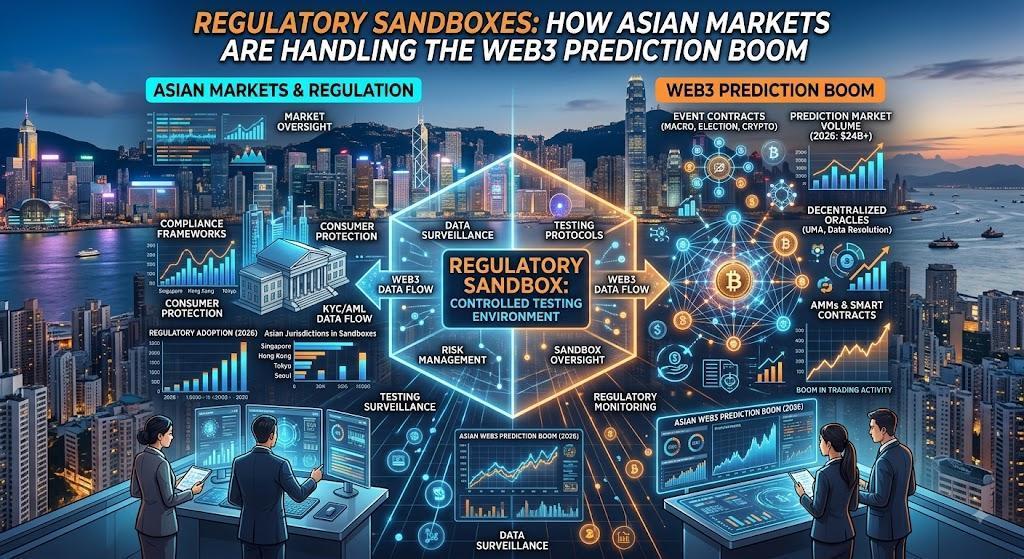
The $24 Billion Gorilla in the Regulatory Room
Wall Street is officially treating event-driven forecasting like a macro-financial asset class. Global prediction market volumes blew past $24 billion a month by mid-2026, forcing an uncomfortable reality onto regulators. This is no longer just retail traders punting on obscure altcoins. Hedge funds and proprietary trading desks are quietly gobbling up block trades to hedge geopolitical risk. The catch? The infrastructure handling this massive capital flow is fractured. You have heavily regulated derivatives exchanges on one side; on the other, permissionless, blockchain-native casinos operate in the dark. Asian policymakers are trapped right in the middle of this mess. They must decide if these novel instruments represent illegal gambling operations or legitimate economic utility. It is a taxonomical nightmare with billions on the line.
The CFTC Baseline and the Utility Test
Asian regulators do not operate in a vacuum. They frequently look toward the United States Commodity Futures Trading Commission (CFTC) as a foundational baseline for evaluating market integrity. The CFTC framework draws a hard, pragmatic line between discrete-action games of chance and event contracts providing meaningful hedging utility. A contract predicting the outcome of a single baseball pitch lacks economic utility; it is pure gambling. On the flip side, a contract forecasting verifiable macroeconomic indicators offers legitimate commercial risk mitigation. This specific utility test is exactly what Asian authorities are currently reverse-engineering to evaluate platforms applying for their domestic regulatory sandboxes.
The Oracle Problem and Five-Minute Heists
Look under the hood of these decentralized Web3 platforms, and the structural cracks become impossible to ignore. Automated market makers execute trades via smart contracts without a single shred of identity verification. Frankly, that is a goldmine for malicious actors. A comprehensive 2026 study from Singapore Management University completely ripped the lid off this vulnerability. Researchers exposed widespread manipulation in short-horizon binary wagers, specifically targeting five-minute Bitcoin contracts. The granular mechanics are deeply unsettling for compliance officers. Bad actors with massive capital reserves would lie in wait until the absolute final moments of a contract cycle. During the exact last ten seconds of the five-minute window, these manipulators executed an anomalous spike in spot order flow on centralized exchanges. They artificially shoved the underlying asset price across the binary strike threshold right as the prediction oracle snapshotted the data. Once the smart contract locked in the fixed payout, the manipulators let the spot price immediately revert. Retail liquidity providers ate 93 percent of those losses. Manipulators systematically captured $8.2 million across roughly 1,600 corrupted cycles. Let's be real; that is a sophisticated smash-and-grab operation.
Reflexivity and the Fix
The empirical data proves that this specific permissionless market structure is profoundly flawed. In cycles where a five-minute market priced an outcome at 90 percent probability just before the close, a late push overturned the outcome 34 percent of the time. The fix, ironically, is incredibly boring. Researchers found that stretching the contract horizon to just fifteen minutes completely neutralized the manipulation. A fake spot price distortion is simply too expensive and risky for manipulators to sustain for a full fifteen minutes against organic market forces. Beyond these micro-level heists, there is a massive macro-level threat known as conditional reflexivity. Prediction markets do not just passively reflect reality anymore. When public probabilities are blasted across mainstream financial terminals, they establish a highly visible focal point for public belief. This dynamic directly influences how political donors act or how algorithmic trading systems allocate capital. We are dealing with recursive financial signaling that actively shapes real-world outcomes. A well-capitalized whale manipulating a decentralized market is artificially manufacturing public consensus and weaponizing financial signals.
Singapore’s Iron Fist and the Sandbox Escape Hatch
Authorities in Singapore did not wait around for academia to suggest longer contract horizons. The Monetary Authority of Singapore (MAS) dropped the hammer early in 2025. They blocked local access to Polymarket entirely and classified unregulated event contracts as illegal betting under the Gambling Control Act. Because these decentralized platforms use digital payment tokens to settle binary options without a localized license, they are criminalized outright. A user attempting to bypass this geoblock faces a $10,000 fine or six months in prison. The legislation leaves zero room for ambiguity. Yet, the MAS is not entirely anti-innovation. They maintain a highly sophisticated FinTech Regulatory Sandbox designed precisely for this kind of high-stakes experimentation. Any builder trying to launch a forecasting protocol in Singapore today must enter this structured pathway. The applicant must mathematically prove their underlying oracle cannot be manipulated, outline a concrete exit strategy, and integrate rigorous AML/CFT safeguards. It is a grueling, evidence-based gauntlet meant to filter out the reckless while sheltering the genuinely innovative.
Hong Kong's ASPIRe and the Margin Call Reality
While Singapore swings a regulatory sledgehammer at unauthorized operators, Hong Kong is quietly courting institutional whales. The Securities and Futures Commission (SFC) recently deployed its ASPIRe roadmap to deliberately bridge the gap between traditional finance compliance and blockchain derivatives. The mechanics here are strictly tailored for institutional risk management. Regulators restrict virtual asset perpetual contracts—instruments operating similarly to continuous event wagers—strictly to Professional Investors. Retail traders are completely locked out of this leverage. Any platform seeking to offer these tools must survive the SFC's dedicated Virtual Asset Sandbox and adhere to brutal margin financing realities. Intermediaries extending credit for virtual asset dealing are legally bound to highly liquid assets like Bitcoin and Ether. The SFC mandates a punitive 60 percent haircut on all virtual asset collateral to absorb sudden liquidation cascades. This is a massive departure from the under-collateralized lending protocols dominating decentralized finance. To further stabilize the ecosystem, Hong Kong allows licensed affiliates to act as Market Makers, narrowing bid-ask spreads for block trades to prevent massive slippage.
Tokyo’s Built-in Cheat Codes
Tokyo solved the microstructure manipulation problem years ago almost by accident. Japanese regulators classify Web3 event contracts as over-the-counter financial derivatives under the Financial Instruments and Exchange Act. The Financial Futures Association of Japan forces all operators to establish a strict base hour for trading periods. Japan preemptively outlawed the exact hyper-short-term settlement manipulation that ravaged decentralized platforms by simply mandating a minimum time horizon.
Institutional Capital Demands a Shorter Leash
The reality is that true global liquidity will never flow into anonymous, permissionless pools over the long haul. Asset managers require determinable settlement finality and ironclad compliance before deploying client capital. That is exactly why we see a massive regulatory pivot toward interoperability and data transparency. Regulators across Asia are aggressively enforcing the FATF Travel Rule, forcing on-chain identity attestations that fundamentally break the pseudonymous nature of DeFi. Policymakers consistently point to the rigorous KYC and AML frameworks maintained by licensed mainstream prediction platforms as their primary baseline for new FinTech legislation. Asian hubs are even launching collaborative cross-border sandboxes to test programmable compliance across multiple jurisdictions simultaneously. The goal is building an interoperable network where compliance data travels as fast as the financial settlement.
The Sovereign Squeeze
Prediction markets have fundamentally evolved from theoretical social experiments into active coordination mechanisms. Unregulated platforms might have proved the underlying concept, but sovereign regulators in Asia are writing the final rules of engagement. They are actively isolating the speculative rot while cannibalizing the viable blockchain tech for state-approved sandboxes. The platforms that survive this brutal transition will not be the loudest Web3 rebels championing absolute decentralization. The undeniable winners will be the compliance-heavy operators willing to embed identity verification directly into their smart contracts. They are permanently trading permissionless chaos for exclusive access to the institutional trillions waiting just outside the gates.