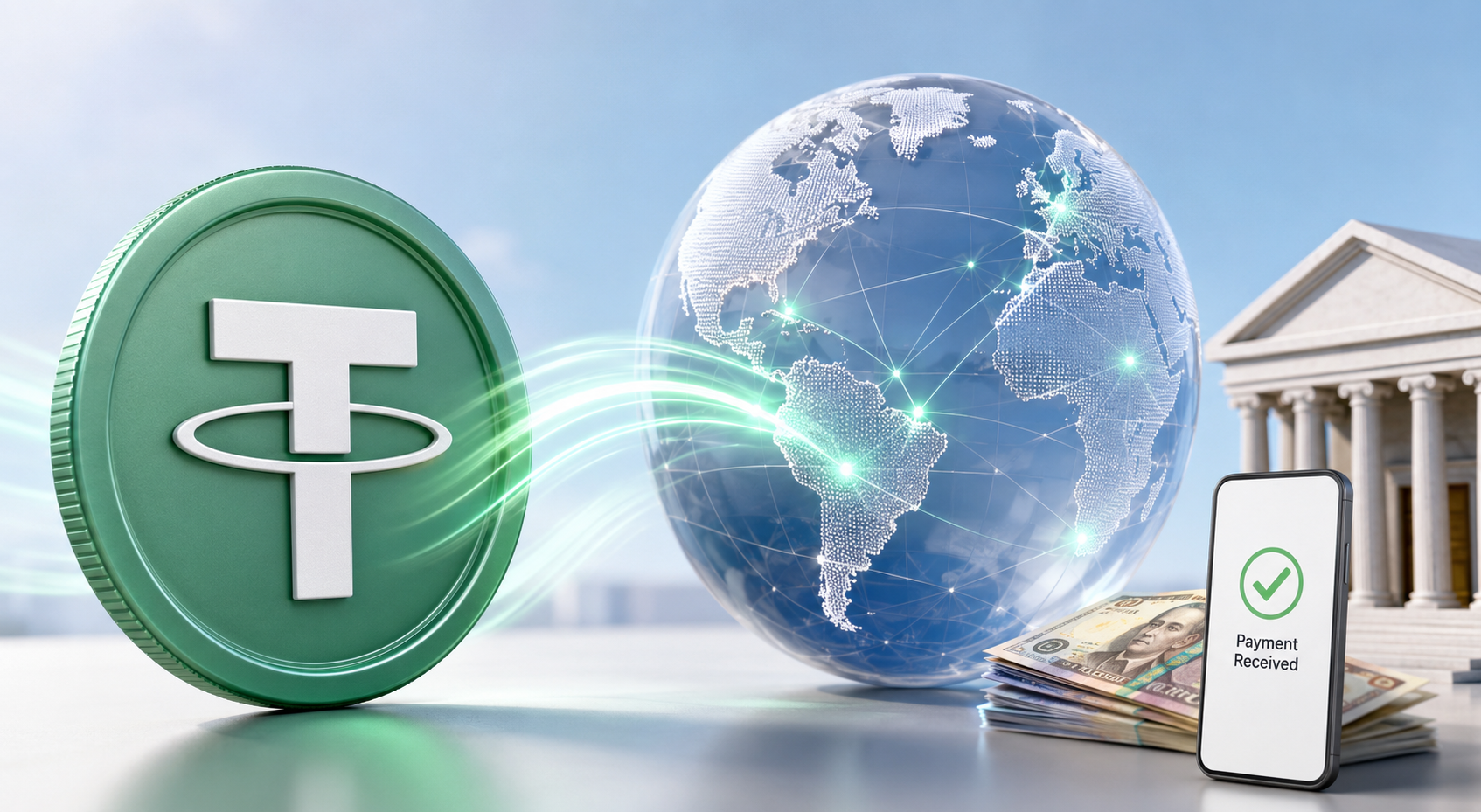
A company paying an overseas supplier can move money through several banks, currencies and settlement systems before the recipient receives usable funds. Dollar stablecoins introduce another route: value can move as a digital dollar on a blockchain, while conversion into local currency can happen at either end. The economics become interesting when this structure solves a specific problem in the payment corridor.
How a Stablecoin Cross-Border Payment Works
A stablecoin transfer usually has three distinct stages: acquiring the digital dollar, moving it on-chain and converting it into the currency the recipient actually needs.
From Local Currency to a Digital Dollar
The first transaction is effectively an FX trade. A user with euros, naira or another local currency acquires USDT or USDC, creating dollar exposure in digital form.
BIS research published in 2026 examined four major dollar stablecoins traded against 27 fiat currencies across 64 exchanges and found that more than 70% of cumulative fiat-to-stablecoin inflows came from non-dollar currencies. For the users making those purchases, acquiring a dollar-pegged token therefore performs a currency-conversion function alongside the transfer function.
A user who needs Tether on TRON can use ChangeNOW to buy TRC20 USDT before sending it through the network, with the choice of TRON determined by the recipient’s wallet support, available liquidity and transaction economics.
The dollar denomination also matters. BIS estimates that roughly 98% of stablecoin value is denominated in U.S. dollars, giving these assets a role that extends beyond crypto trading and into digital access to dollar liquidity.
The On-Chain Transfer
After acquisition, the sender can transfer the stablecoin directly to a compatible wallet address. The blockchain records the transaction and provides a shared settlement record, while the payment can proceed independently of traditional bank cut-off times.
A practical overview of blockchain cross-border payments shows why this model appeals to international payment operators: blockchain-based settlement can reduce the reconciliation work created when several institutions maintain separate transaction records.
The efficiency depends on the network and the surrounding infrastructure. A low-cost blockchain transfer provides limited value if the recipient cannot access the asset, if liquidity is thin or if the destination market imposes high conversion costs.
The Local-Currency Exit
The final stage brings traditional finance back into the process. A recipient can hold the stablecoin, spend it through a supported payment product or sell it for local currency and transfer the proceeds to a bank account.
This is where corridor economics become visible. A transfer can settle on-chain within minutes while the full transaction remains expensive because of FX spreads, exchange fees or the cost of converting the digital dollar into local money.
For that reason, stablecoin payment infrastructure increasingly combines wallets, compliance controls, liquidity management and fiat payout services. The blockchain transfer is only one component of the payment.
Where Stablecoins Are Finding Practical Use
The strongest evidence comes from markets where dollar access and international settlement already create operational pressure.
Nigeria: Stablecoins as a Cross-Border Dollar Channel
Nigeria provides one of the clearest examples. The IMF reports that Nigeria received about $59 billion in crypto-asset inflows between July 2023 and June 2024, while stablecoins accounted for more than 65% of crypto inflows in 2024. USDT and USDC dominate the country’s stablecoin market, and stablecoin inflows have grown to a scale approaching recorded remittance inflows.
The reasons are closely connected to local economic conditions. Naira depreciation, inflation and limited access to foreign currency increased demand for dollar-linked assets. Stablecoins gave households and businesses a way to hold and transfer dollar value through digital wallets, including for overseas payments and remittances.
The regulatory history is equally instructive. When Nigeria’s central bank instructed banks in 2021 to stop servicing crypto exchanges and users, activity shifted toward peer-to-peer channels. The IMF subsequently observed that stablecoins became a primary medium of exchange in those channels.
Nigeria therefore shows two sides of the same payment mechanism. Stablecoins can improve access to cross-border dollar liquidity while also moving some currency activity outside traditional banking channels.
Business Payments and Treasury
Commercial payments create a different use case because the recipient may already operate a treasury function capable of holding or converting digital dollars.
Visa has described examples involving international payroll, supplier payments and treasury transfers between corporate entities. A U.S. company paying a supplier in Vietnam, for instance, can use stablecoin infrastructure for the settlement leg while local financial partners handle the recipient’s eventual conversion.
For a company making frequent international payments, the benefit can come from operational control rather than transaction speed alone. Treasury teams can maintain digital-dollar liquidity, schedule transfers and reconcile blockchain transactions with internal records.
The model becomes more compelling when several payments follow the same corridor. A single wire transfer may offer little reason to change infrastructure. Hundreds of recurring payouts create a different calculation because settlement timing, liquidity management and reconciliation costs accumulate.
Stablecoins vs. Existing Cross-Border Payment Rails
Stablecoins compete with several established approaches, each solving a different part of international money movement.
|
Payment model |
Strongest use case |
Main constraint |
|
Correspondent banking |
Regulated fiat settlement across established banking corridors |
Multiple intermediaries, cut-off times and reconciliation |
|
Instant-payment networks |
Low-cost domestic payments and connected regional systems |
Cross-border interoperability remains limited |
|
Stablecoins |
Digital-dollar settlement and programmable international payouts |
Regulation, liquidity and fiat conversion |
|
Tokenized bank money |
Institutional settlement between regulated financial entities |
Availability depends on participating institutions and networks |
This comparison also shows why stablecoins are unlikely to replace every existing rail. Domestic instant-payment systems can already process local transactions efficiently, while banks provide direct access to fiat balances and established compliance frameworks.
Tokenized deposits create another competitive route. BIS’s Project Agorá is testing how tokenized commercial bank deposits and tokenized central bank money can support multi-currency transactions within a unified platform.
Stablecoins have a different starting point because public blockchain networks already provide global transfer infrastructure and deep crypto-market liquidity. Their commercial value will depend on how reliably that liquidity connects to regulated financial institutions and local payment systems.
Regulation and the Reliability of Digital Dollars
The legal status of a stablecoin affects its usefulness as directly as transaction speed or network fees.
MiCA has already changed the availability of certain stablecoins for European users, while the United States has established a federal framework for payment stablecoins through the GENIUS Act. For payment companies, regulatory classification determines which assets can be offered, which institutions can interact with them and how redemption and reserve requirements are handled.
The market has already provided a useful stress test for the underlying model. In March 2023, USDC temporarily traded below its dollar peg after Circle disclosed that $3.3 billion of its reserves were held at Silicon Valley Bank. The amount represented about 8% of USDC’s total reserves at the time. After U.S. authorities guaranteed depositors’ access to their funds, Circle confirmed that the reserve deposit would become fully available and the peg recovered.
The episode showed why stablecoin settlement cannot be evaluated solely through blockchain performance. The token may transfer continuously while its dollar value still depends on reserves, banking relationships, redemption arrangements and market confidence.
For emerging markets, the macroeconomic question is larger. BIS estimates that about 98% of stablecoin value is dollar-denominated and argues that widespread adoption could reinforce the international role of the dollar. In economies with weaker currencies, stablecoins can also accelerate digital dollarization by giving households and companies convenient access to foreign-currency liquidity.
Three Scenarios for Cross-Border Stablecoin Payments
Base: A Specialized Settlement Rail
Stablecoins become another settlement option for selected corridors, particularly where dollar liquidity is valuable and conventional international payments involve high operational friction. Banks and payment companies continue to control the fiat entry and exit points, while stablecoins handle part of the movement between them.
Optimistic: Stablecoins Disappear From the User Interface
Payment providers abstract away the blockchain layer. A business submits an international payout in its existing treasury system, while the provider selects the stablecoin, network and liquidity route in the background. The recipient receives local currency through a conventional account or payment method.
Under this model, adoption depends less on consumers wanting to own crypto and more on whether stablecoin settlement reduces the provider’s cost and improves liquidity.
Stress: Fragmented Digital-Dollar Corridors
Regulatory differences could produce separate pools of stablecoin liquidity, while domestic instant-payment systems and tokenized bank money gain ground in major financial centers.
Stablecoins would still serve crypto-native businesses, remittance corridors and markets with strong demand for dollar liquidity, although their role in mainstream international payments would remain concentrated rather than universal.
Where Digital Dollars Fit Next
Stablecoins have become a practical cross-border settlement tool in specific markets, with Nigeria showing how dollar-linked digital assets can connect households and businesses to international liquidity when conventional access is constrained. Their wider adoption will depend on the infrastructure around the token: compliant access, local FX liquidity, reliable redemption and connections to domestic payment systems.
The strongest case for digital dollars therefore lies in payment corridors where those components solve a measurable problem rather than simply adding another way to move money.
FAQ
Can stablecoins replace correspondent banking?
They can reduce the role of correspondent banks in selected settlement flows, while banks and regulated payment providers remain important for fiat conversion, compliance and local payouts.
Does the recipient need a crypto wallet?
A direct blockchain transfer requires a compatible wallet or address. Payment providers can also receive the stablecoin and handle conversion before the recipient receives local currency.
Why are dollar stablecoins so dominant?
Dollar stablecoins combine blockchain transferability with exposure to the currency used extensively in international trade and finance. BIS estimates that around 98% of stablecoin value is dollar-denominated.
Are stablecoin transfers cheaper than bank wires?
The blockchain transaction can be inexpensive, although the full payment cost also includes FX conversion, liquidity, exchange fees and fiat payout costs.
Can stablecoins be used for business treasury?
Yes. Companies can use them for supplier payments, intercompany transfers and international liquidity management where the relevant jurisdictions and service providers permit those activities.
Why does the blockchain network matter?
Networks differ in fees, liquidity, wallet compatibility and transaction capacity. The appropriate choice depends on the complete payment route and the recipient’s ability to access the asset.
Are stablecoins widely used for remittances?
Their use is significant in some emerging markets. Nigeria is a particularly strong example, where stablecoins accounted for more than 65% of crypto inflows in 2024 and stablecoin inflows approached recorded remittance inflows.
Could stablecoins increase dollarization?
Yes. Their widespread use can give households and businesses easier access to dollar liquidity, which can reduce demand for local currency in economies experiencing inflation or currency instability.
What competes with stablecoin payments?
Correspondent banking, instant-payment networks and tokenized deposits all compete for parts of the same cross-border settlement function, with each model offering different combinations of liquidity, regulatory access and settlement speed.
What should a company assess before using stablecoins?
The relevant factors include the payment corridor, regulatory requirements, stablecoin liquidity, FX spreads, redemption options, network support and integration with existing treasury and compliance systems.
Disclaimer
This article is provided for informational purposes only and does not constitute financial, investment, legal or tax advice. Stablecoin regulation, availability, liquidity and transaction costs vary by jurisdiction and may change. Businesses and individuals should conduct independent due diligence and obtain appropriate professional advice before making financial decisions.