
Fintech runs on trust, speed, and data, which is exactly what makes it a magnet for attackers. Financial services entered 2026 as the most attacked industry on the internet, with the average breach costing 5.56 million dollars, second only to healthcare. Add faster, AI-driven attacks and a tightening web of regulation, and the pressure on fintech security teams has never been higher. That is why a growing number of firms now hand detection and response to specialists rather than trying to keep pace alone. This article looks at why fintech is such a target, what shifted this year, and why the approach has become the practical answer for firms that cannot afford to blink. The trend is not about chasing the latest tool; it is about matching the speed and scale of the threats fintech now faces.
Key Takeaways
- Financial services is the most attacked sector, with breaches averaging well over five million dollars each.
- In 2025, 45% of financial firms faced AI-powered attack attempts, and two-thirds were hit by ransomware.
- New rules like DORA and faster attacks have pushed real-time defense to the top of the agenda.
- A managed, AI-driven service gives fintechs 24/7 monitoring, real-time fraud detection, and fast containment.
- The trade-offs of cost, data quality, and governance are real but manageable with the right approach.
Why Fintech Is a Prime Target
Few sectors concentrate value the way fintech does. A single platform may hold payment credentials, identity documents, transaction histories, and direct access to money. That mix draws attackers, and the numbers show it. Grasping the risk is the first step toward understanding the shift to AI managed security now underway across the industry.
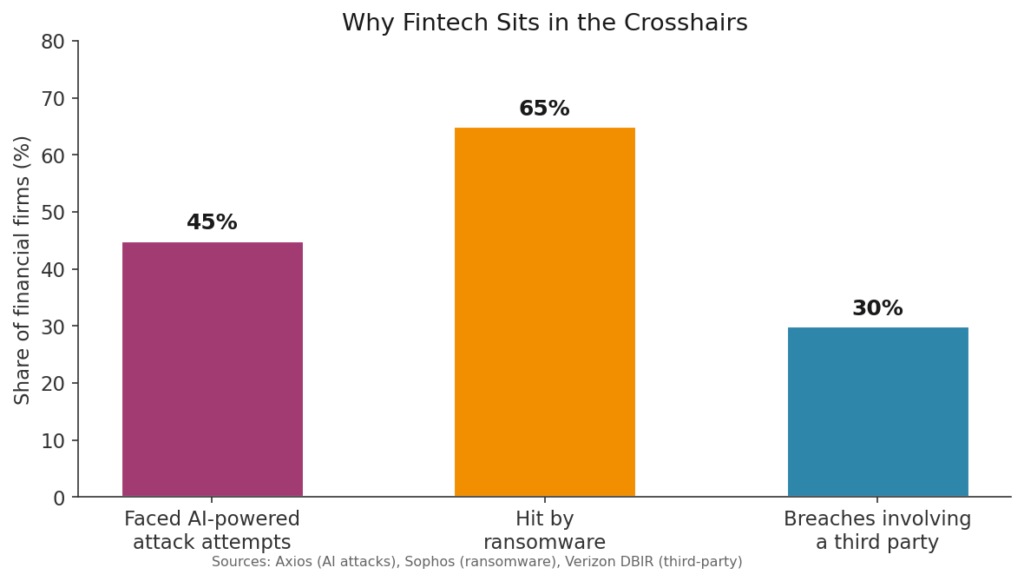
By almost every measure, finance carries more risk than any other sector.
The exposure runs wider than a firm’s own walls. Modern fintechs depend on APIs, cloud providers, and partners, and breaches involving a third party have doubled to 30% of the total. For an industry built on protecting sensitive financial data, every connection is both a feature and a potential door. A single compromised vendor can cascade across many firms at once, as recent incidents in the sector have shown. For attackers, that interconnection turns one weak link into a payday spanning dozens of institutions. That concentration risk is now one of the sector’s defining exposures.
What Changed in 2026
Two forces turned a hard problem into an urgent one. First, attackers adopted AI at scale. Nearly half of all financial firms fielded AI-driven attack attempts in the past year, from deepfake-driven fraud to phishing that adapts on the fly, and automation now compresses what was once a multi-day ransomware campaign into roughly 25 minutes.
Second, regulators caught up. The EU’s Digital Operational Resilience Act became enforceable in January 2025, with penalties reaching 2% of global turnover, while US and Asian regulators tightened incident-reporting and resilience rules in parallel. For a fuller picture of these pressures, fintech cybersecurity in 2026 is worth a closer look. Together, faster attacks and stricter rules leave little room for slow, manual defense. The result is a widening gap between how quickly an attack unfolds and how quickly a lean in-house team can react. Closing that gap by hand is no longer realistic, which is precisely what pushes firms toward outside expertise.
A Natural Fit for Financial Firms
This approach answers those pressures directly. Delivered as a security operations center offered as a service, it pairs machine intelligence with human analysts who watch a firm’s systems around the clock, without the cost of building that team in-house. For most fintechs, the economics alone are decisive, since a fully staffed in-house operation can run past 700,000 dollars a year. A subscription that spreads that cost across many clients is simply more sustainable for a growing firm.
|
Fintech challenge |
How the service helps |
|
Millions of real-time transactions |
Spots fraud and anomalies instantly at scale |
|
No round-the-clock in-house SOC |
Continuous monitoring as a subscription |
|
Strict, overlapping regulations |
Audit-ready evidence and faster reporting |
|
Sprawling APIs and cloud services |
Watches the whole attack surface |
|
Scarce, costly security talent |
Expert coverage without new hires |
The fit is especially strong for fraud. The same AI-powered fraud detection that scans millions of transactions for anomalies also spots the intrusions that precede theft, learning normal behavior and flagging what strays from it. Because the models keep learning, they grow sharper over time, catching newer schemes that a fixed rulebook would miss entirely.
“Financial institutions that have adopted AI models for fraud detection have seen transformative results.” FS-ISAC
The Payoff and the Trade-offs
The benefits are concrete, and so are the numbers behind them.
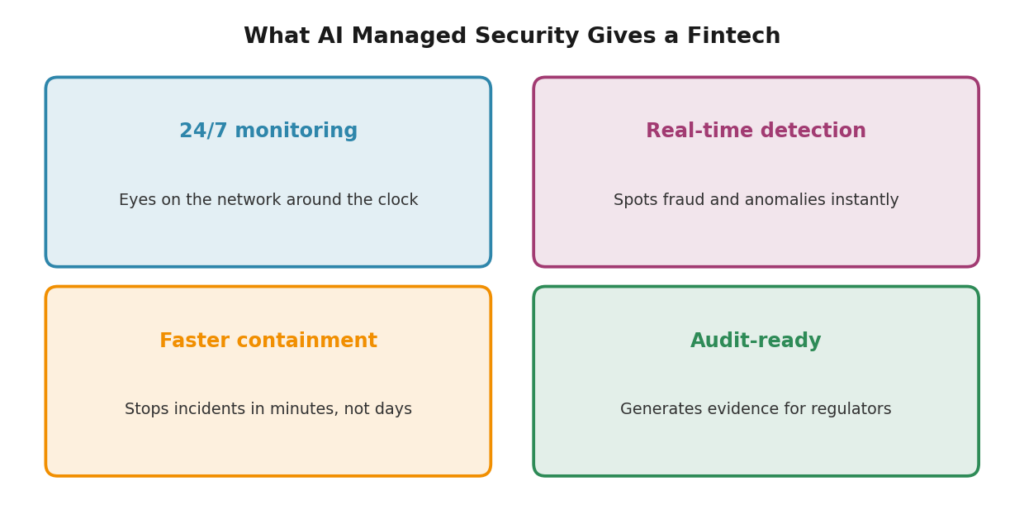
Four capabilities that map directly to a fintech’s biggest pain points.
|
Key stat: organizations that use AI extensively in their defenses save close to 1.9 million dollars per breach and contain incidents about 80 days faster, according to IBM. |
None of that makes AI a magic fix. It carries real trade-offs that fintech leaders should plan for, and skipping them is how good tools still produce bad outcomes.
|
Consideration |
What to do about it |
|
Upfront cost |
Start with the highest-risk systems |
|
Data quality |
Feed clean, well-governed data |
|
False positives |
Tune models and keep humans reviewing |
|
AI governance |
Set policy, controls, and audit trails |
|
Regulated data in AI |
Map where AI can and cannot operate |
|
Warning: AI is only as good as its data and governance. Feeding regulated financial data into a poorly controlled tool can create the very compliance problem you are trying to avoid. |
On that point, maintaining patch compliance and clean data hygiene still matter as much as the model itself, since attackers exploit the basics long before they reach the algorithm. Handled well, these points are not reasons to hesitate but a checklist to work through before and during rollout. The firms that get the most value treat it as an ongoing discipline, not a one-time setup task.
Making the Move
Moving to a managed model does not mean an overnight overhaul. Most fintechs start by mapping their gaps, then layering managed detection over the controls they already run. A fully managed or co-managed setup lets a firm gain enterprise-grade coverage while keeping its own team focused on the calls that need human judgment.
[Video: “AI in Financial Crime: How Banks Detect Fraud in 2026”: https://www.youtube.com/watch?v=m6XUHucbS4g]
This short breakdown shows how banks and fintechs use AI to detect fraud and financial crime today.
Whatever the path, the foundations still count: strong access controls, clean data, and clear human oversight of what the system decides. Reviewing the arrangement regularly matters too, because a fintech’s risk profile shifts with every new product, market, and partner it takes on.
|
Pro tip: before signing, ask a provider how fast they detect and contain a real threat, and how they support your specific regulatory obligations. Outcomes and compliance fit matter more than a long feature list. |
Frequently Asked Questions
What does AI-driven managed security involve?
It is an outsourced service that combines AI threat detection with human analysts to watch a firm’s environment day and night, catch fraud and intrusions in real time, and respond fast, without building an in-house team.
Why is fintech targeted so heavily?
Fintech platforms concentrate money, identity data, and transaction access, and they connect to many partners and APIs. That value and complexity make them among the most attacked organizations online. The reward for a successful breach is immediate and financial, which keeps the target on their backs.
How does AI help with fraud specifically?
AI models learn normal transaction behavior and flag anomalies instantly across millions of events, catching fraud and account takeover far faster than static, rule-based systems. The same engine also trims false alarms as it learns, so genuine threats stand out.
Does it help with compliance?
Yes. Continuous monitoring, faster detection, and audit-ready reporting support frameworks like DORA, PCI DSS, and regional financial rules, though the firm still owns overall compliance. Treat the provider as a partner in that effort, not a replacement for it.
What should fintechs watch out for?
Cost, data quality, false positives, and AI governance. Regulated data fed into weakly controlled AI can create new risk, so oversight and clean data remain essential.
From Option to Expectation
For fintech, the math of 2026 is simple. Attacks are faster and smarter, regulators are stricter, and the cost of a breach is among the highest of any sector. Trying to match machine-speed threats with manual, business-hours defense is a losing bet. An AI-led managed approach offers a way to close that gap: continuous, intelligent monitoring backed by human experts, sized to a firm’s risk and budget. It is not a cure-all, and it works best on strong foundations with people in the loop. The firms that win will treat it as core infrastructure rather than an afterthought. But for firms with no room for error, it has quickly become the default expectation.
References
IBM, Cost of a Data Breach Report 2025. https://www.ibm.com/reports/data-breach
Verizon, 2025 Data Breach Investigations Report. https://www.verizon.com/business/resources/reports/dbir/
World Economic Forum, Global Cybersecurity Outlook 2026. https://www.weforum.org/publications/global-cybersecurity-outlook-2026/
European Commission, Digital Operational Resilience Act (DORA). https://finance.ec.europa.eu/regulation-and-supervision/financial-services-legislation/implementing-and-delegated-acts/digital-operational-resilience-act_en
NIST, Cybersecurity Framework (CSF) 2.0, 2024. https://www.nist.gov/cyberframework
Fact Check: All statistics and data points in this article were verified against original sources as of July 6, 2026. Sources are listed in the References section.